
Post Summary
Because alternatives platforms are expanding access to private-market products, and that expansion creates a responsibility to ensure independent sponsor intelligence grows alongside it, rather than access outpacing oversight.
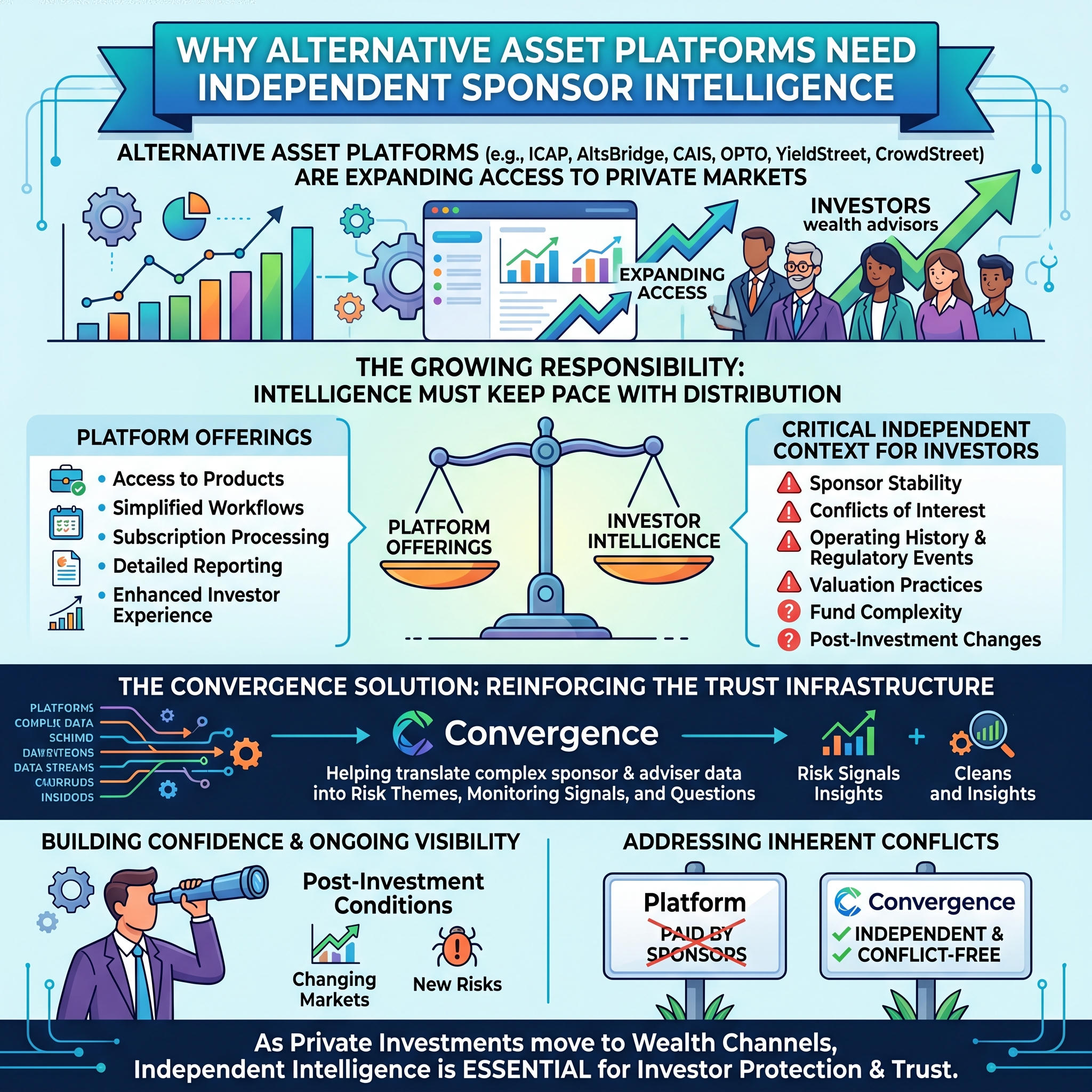
Platforms can offer access, workflow, subscription processing, reporting, and investor experience, but investors also need independent context on sponsor stability, conflicts, operating history, regulatory events, valuation practices, fund complexity, and post-investment changes.
Convergence helps translate complex sponsor and adviser data into risk themes, monitoring signals, and questions that platforms and investors can use, explicitly framed as strengthening trust infrastructure rather than replacing platform diligence.
Because as more private investments move into wealth channels, the volume and reach of retail-facing private-market access grows, making independent oversight of sponsors more consequential at scale.
Ongoing visibility into the sponsor and the conditions that may change after the investment is made, since access alone is described as only one part of the investor experience.
Why Must Sponsor Intelligence Keep Pace with Distribution?
Alternatives platforms are expanding access to private-market products.
That creates an important responsibility: sponsor intelligence must keep pace with distribution.
What Do Platforms Provide, and What Do Investors Also Need?
A platform can offer access, workflow, subscription processing, reporting, and investor experience. But investors also need independent context on sponsor stability, conflicts, operating history, regulatory events, valuation practices, fund complexity, and post-investment changes.
What Role Does Convergence Play?
That is the role Convergence can play.
We help translate complex sponsor and adviser data into risk themes, monitoring signals, and questions that platforms and investors can use.
This is not about replacing platform diligence. It is about strengthening the trust infrastructure around private-market access.
Why Does This Matter More as Private Investments Move Into Wealth Channels?
The more private investments move into wealth channels, the more important independent intelligence becomes.
What Does Confidence Require Beyond Access?
Access is only one part of the investor experience.
Confidence requires ongoing visibility into the sponsor and the conditions that may change after the investment is made.
Key Points
Why does this piece argue sponsor intelligence must keep pace with platform distribution?
- The context is framed around expanding access: The piece states "alternatives platforms are expanding access to private-market products."
- A specific responsibility is named as a direct consequence of that expansion: The piece states this expansion "creates an important responsibility: sponsor intelligence must keep pace with distribution."
- This framing positions oversight as a parallel requirement to growth, not an afterthought: The piece does not argue against platform expansion, but argues that intelligence infrastructure must scale alongside it.
What do platforms provide, and what additional independent context do investors need, according to this piece?
- Five specific platform functions are named directly: Platforms "can offer access, workflow, subscription processing, reporting, and investor experience."
- Seven specific investor needs are named as distinct from platform functions: Investors "need independent context on sponsor stability, conflicts, operating history, regulatory events, valuation practices, fund complexity, and post-investment changes."
- The distinction is explicitly drawn between platform capability and independent oversight: The piece implies platforms are well-suited to deliver access and process, but not necessarily positioned to provide independent sponsor-level risk context on their own.
What role does Convergence claim to play, and how is this role explicitly bounded?
- Convergence's function is described as translation: The piece states Convergence helps "translate complex sponsor and adviser data into risk themes, monitoring signals, and questions that platforms and investors can use."
- The role is explicitly distinguished from replacing platform diligence: The piece states directly, "this is not about replacing platform diligence."
- The role is instead framed around trust infrastructure: The piece states it "is about strengthening the trust infrastructure around private-market access," positioning Convergence as complementary to, not competitive with, platform-level diligence processes.
Why does this piece argue independent intelligence becomes more important as private investments move into wealth channels?
- A direct causal relationship is stated: "The more private investments move into wealth channels, the more important independent intelligence becomes."
- This connects to the piece's opening responsibility argument: As private-market products reach a broader, less institutionally sophisticated investor base through wealth channels, the piece implies the stakes of inadequate sponsor oversight grow correspondingly.
What does this piece say is required for investor confidence beyond simple market access?
- Access is explicitly described as only partial: The piece states "access is only one part of the investor experience."
- Ongoing, not one-time, visibility is named as the additional requirement: The piece states "confidence requires ongoing visibility into the sponsor and the conditions that may change after the investment is made."
- This closing argument parallels the recurring monitoring theme in Convergence's related retail investor piece: Both pieces emphasize that risk assessment does not end at the point of initial investment, but requires continued attention to conditions that can change afterward.