
Post Summary
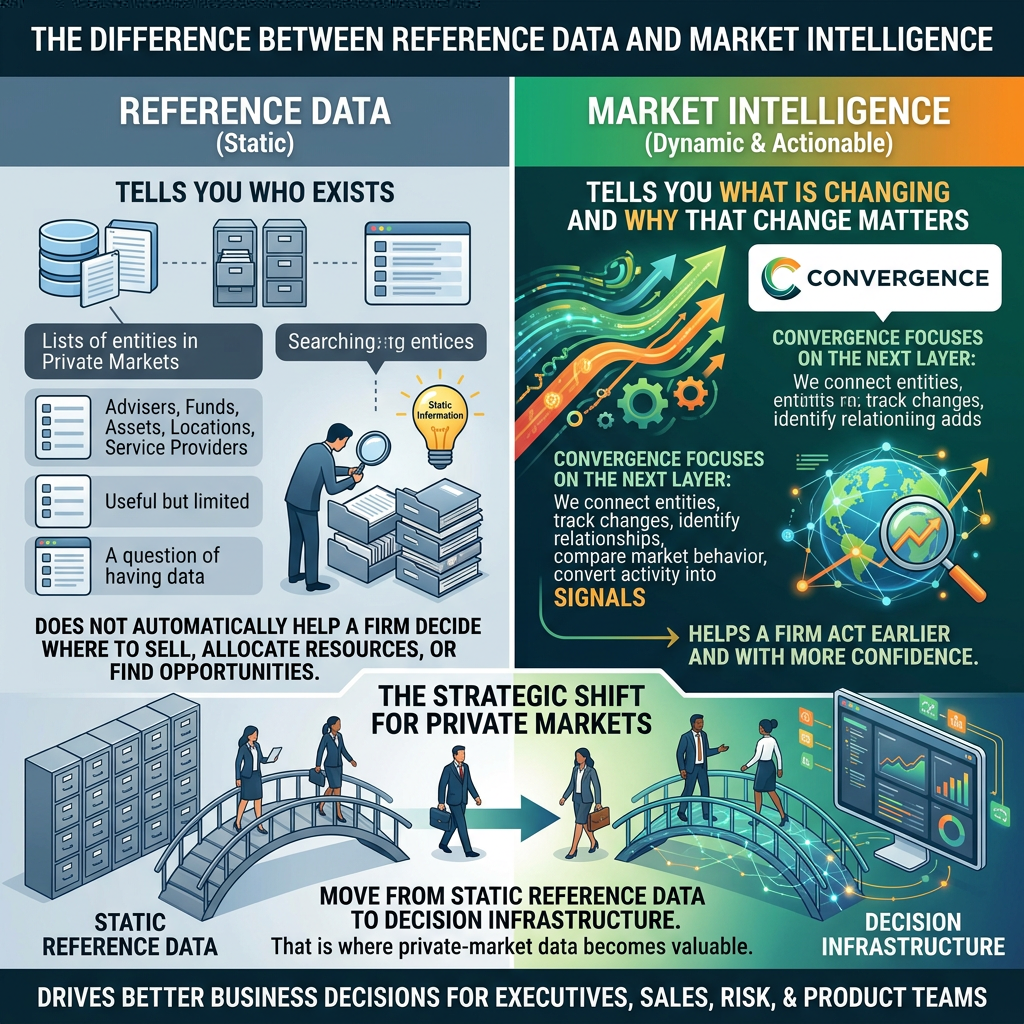
Reference data tells you who and what exists, while market intelligence tells you who and what is about to change and why it matters.
Because databases listing advisers, funds, assets, locations, and service providers are useful but do not help a firm decide where to sell, where to allocate resources, where risk is increasing, or where the market is moving.
It connects entities, identifies relationships, compares market behavior, tracks business activity, and creates forward-looking signals.
Not whether a firm has data, but whether the data helps the firm act earlier and with more confidence.
Executives, sales leaders, risk teams, and product teams.
What Is the Difference Between Reference Data and Market Intelligence?
Reference data tells you who and what exists. Market Intelligence tells you who and what is about to change and why it matters.
Why Isn't Reference Data Enough for Private Markets?
That distinction is important in private markets. The industry has plenty of databases that list advisers, funds, assets, locations, and service providers. Those lists are useful, but they do not help a firm decide where to sell, where to allocate resources, where risk is increasing, or where the market is moving.
What Does Convergence's Market Intelligence Layer Do?
Convergence focuses on the next layer by connecting entities, identifying relationships, comparing market behavior, tracking business activity and creating signals telling you where the "puck is going." decisions.
What Is the Real Question Firms Should Be Asking About Their Data?
The question is not whether a firm has data. The question is whether the data helps the firm act earlier and with more confidence.
Who Benefits From Moving to Decision Infrastructure?
For executives, sales leaders, risk teams, and product teams, the opportunity is to move from static reference data to decision infrastructure.
That is where private-market data becomes valuable.
Key Points
How does this piece define reference data, and what are its limits?
- Reference data is defined narrowly around existence, not change: The piece states reference data "tells you who and what exists."
- Specific examples are named directly: The industry has "plenty of databases that list advisers, funds, assets, locations, and service providers."
- These lists are explicitly acknowledged as useful, but incomplete: The piece states these lists "are useful, but they do not help a firm decide where to sell, where to allocate resources, where risk is increasing, or where the market is moving."
- Four specific decision gaps are named: The named gaps are deciding where to sell, where to allocate resources, where risk is increasing, and where the market is moving.
How does this piece define market intelligence, and what specific capabilities does Convergence claim in this layer?
- Market intelligence is defined around change and significance: The piece states it "tells you who and what is about to change and why it matters."
- Five specific capabilities are named for Convergence's market intelligence layer: "Connecting entities, identifying relationships, comparing market behavior, tracking business activity and creating signals."
- The output is framed using a forward-looking business idiom: The piece describes these signals as telling firms "where the 'puck is going,'" a common business expression for anticipating future direction rather than reacting to the present.
What is the real question this piece argues firms should be asking about their data?
- The question of data possession is explicitly set aside: The piece states "the question is not whether a firm has data."
- The real question is reframed around actionability and timing: "The question is whether the data helps the firm act earlier and with more confidence."
- This reframing directly echoes the reference-data-versus-market-intelligence distinction made earlier: Having data (reference data) is distinguished from having data that changes decision timing and confidence (market intelligence).
Who does this piece identify as benefiting from the shift to decision infrastructure, and how is that shift framed?
- Four specific functional roles are named directly: "Executives, sales leaders, risk teams, and product teams" are identified as the intended beneficiaries.
- The shift is framed as moving from a static to a dynamic data function: The piece describes "the opportunity to move from static reference data to decision infrastructure."
- The piece closes by locating the source of data's value specifically: "That is where private-market data becomes valuable," tying value directly to the decision-infrastructure function rather than to data volume or existence alone.